.png)
July 2026 - Week 1 Roundup
Updated: Jul 6
28th June - 4th July 2026
Leopard
Sighted on: 04.July.2026

At 23:04, our trail camera trap captured a leopard visiting the lodge waterhole. After quenching its thirst, the cat paused briefly in the stillness of the Kalahari before disappearing silently into the night. A beautiful reminder that even while we sleep, the wilderness around the lodge remains alive.

Content Creator / Photographer:
Zizie Seitaa
Elephants
Sighted on: 03.July.2026

Today's highlights included an African elephant moving through our reserve, calmly feeding among the Kalahari thornveld. Elephant movements play an important role in shaping the ecosystem by opening pathways, dispersing seeds, and creating habitats for many other species.
Content Creator / Photographer:
Zizie Seitaa
Red-billed Spurfowl
Sighted on: 03.July.2026

We also observed a Red-billed Spurfowl, one of the most common and recognizable ground birds across the Kalahari ecosystem. Often seen foraging along roadsides and beneath thorn bushes, this hardy species is well adapted to the arid environment and is a familiar sight on every safari.
Content Creator / Photographer:
Zizie Seitaa
Black-backed Jackal
Sighted on: 01.July.2026

On the endless white roads of Deception Valley, silence often tells the greatest stories. An ancient fossilized river valley in the heart of the Central Kalahari Game Reserve, its sweeping golden plains, shimmering mirages, and open landscapes create one of Botswana's most remarkable wildlife habitats. Here, predators and plains game roam freely, perfectly adapted to the rhythms of the Kalahari.
At Evolve Back, we believe the most memorable safari moments are found in these quiet encounters-watching wildlife in its natural habitat, surrounded by untouched wilderness. It's this sense of stillness, authenticity, and connection to nature that stays with you long after the journey ends.
Content Creator / Photographer:
Zizie Seitaa
Southern Giraffe
Sighted on: 30.June.2026

The morning game drive across the reserve yielded an exceptional encounter with a small southern giraffe nursery herd consisting of two adult females and a highly vulnerable newborn calf estimated to be only a few weeks old. The young calf utilized the lower thorny scrub layer for protective cover and physical camouflage, while the adults maintained an active protective flank, standing as elevated sentinels to scan the horizon for apex predators. In this semi-arid environment, these megaherbivores act as vital ecological drivers by targeting upper-canopy layers of Vachellia and Senegalia species, pruning them into distinct browse lines that open up light channels for sub-canopy flora. Furthermore, their extreme metabolic efficiency allows them to derive nearly all structural moisture from succulent new shoots, granting them complete independence from permanent surface water holes during dry spells.

Content Creator / Photographer:
Mogomotsi Maboga
Bat - eared Fox
Sighted on: 30.June.2026

A family group of three bat-eared foxes was encountered operating out along an open, sandy pan margin during the crisp morning golden hour. The individuals demonstrated classic social foraging mechanics, alternating between low-headed scanning and sudden, localized visual focus toward the game viewer while pitching their enormous, highly vascularized ears forward to map audio frequencies. These micro-predators showcase premier evolutionary specialization for the arid Kalahari basin, relying on their massive ears to detect the subsurface vibrations of harvester termites (Hodotermes mossambicus) and beetles, which constitute up to 90% of their diet. Their rapid sand-digging behavior plays a significant role in local soil aeration and nutrient distribution, while their oversized ears act as highly efficient radiator fins to dissipate thermal stress during high-temperature periods. Because their high-moisture insect diet fulfills their hydration needs, these foxes rarely require standing water.
Content Creator / Photographer:
Mogomotsi Maboga
Greater Kudu
Sighted on: 30.June.2026

Along a dense woodland thicket line, two adult Greater Kudu bulls displaying magnificent, fully formed spiral horns were observed moving cautiously. They maintained a highly vigilant stance at the ecotone, blending effortlessly with the dappled light and woody brush due to their vertical white torso stripes, which provide exquisite disruptive camouflage against the vertical branches. Greater Kudu act as specialized intermediate browsers in the Kalahari, using dense thickets for both thermoregulation and nutrition. When grass cover is thin or dried out, these antelope rely heavily on deep-rooted shrubs, seed pods, and succulent leaves, safely utilizing the thorny brush as a physical barrier against large predators.
Content Creator / Photographer:
Mogomotsi Maboga
Crimson - breasted Shrike
Sighted on: 30.June.2026

A single Crimson-breasted Shrike was sighted actively foraging on the open ground substrate. This striking bird, sporting a brilliant crimson underbelly contrasted against a jet-black back, moved with agility across the sand, searching the leaf litter for terrestrial invertebrates. As a highly specialized avian endemic to the acacia-savanna of Southern Africa, this shrike behaves as a terrestrial foraging specialist, hopping nimbly to harvest beetles, caterpillars, and other ground-dwelling insects. While its bold, vivid red coloration is highly visible out in the open, it plays a critical role in territorial mapping and intra-species communication within the lower scrub canopies.
Content Creator / Photographer:
Mogomotsi Maboga
Lions
Sighted on: 30.June.2026

The morning's tracking concluded with a spectacular encounter with a lion pride consisting of multiple sub-adults and young individuals moving along and resting adjacent to a sandy track. One young male with a developing mane was noted walking purposefully across an open stretch, exhibiting typical exploratory behavior and excellent physical body condition, while the other pride members remained low in a relaxed posture along the white sand vehicle track. The presence of these apex carnivores utilizing sandy tracks and open pan margins demonstrates typical Kalahari carnivore spatial dynamics. Lacking permanent surface water throughout much of the year, these apex predators rely on the moisture of their prey and supplementary wild tsamma melons, traveling vast distances across open ecotones to monitor game movements and using the cool early morning hours to navigate without excessive thermal stress.
Content Creator / Photographer:
Mogomotsi Maboga
Lions
Sighted on: 28.June.2026


During the morning game drive, we had a fantastic encounter with a lion pride consisting of an adult lioness and three healthy, alert cubs. The pride was initially found sunbathing and resting directly on the sandy track, exhibiting very relaxed behavior in the presence of the vehicle, before the lioness led the sub-adults on a slow patrol further down the road.
Content Creator / Photographer:
Mogomotsi Maboga
White - crested helmetshrikes
Sighted on: 28.June.2026
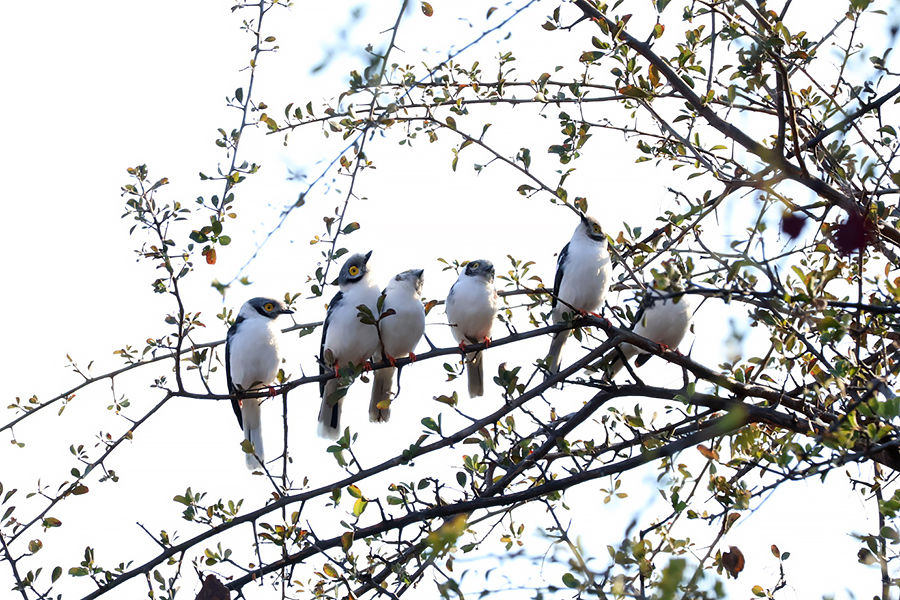
In addition to the big cat activity, we recorded a superb avian sighting of a tightly knit party of seven White-crested helmetshrikes foraging collaboratively through the thorn bush canopy.
Content Creator / Photographer:
Comments