.png)
May 2026 - Week 3 Roundup
Boomslang
Sighted on: 23.May.2026
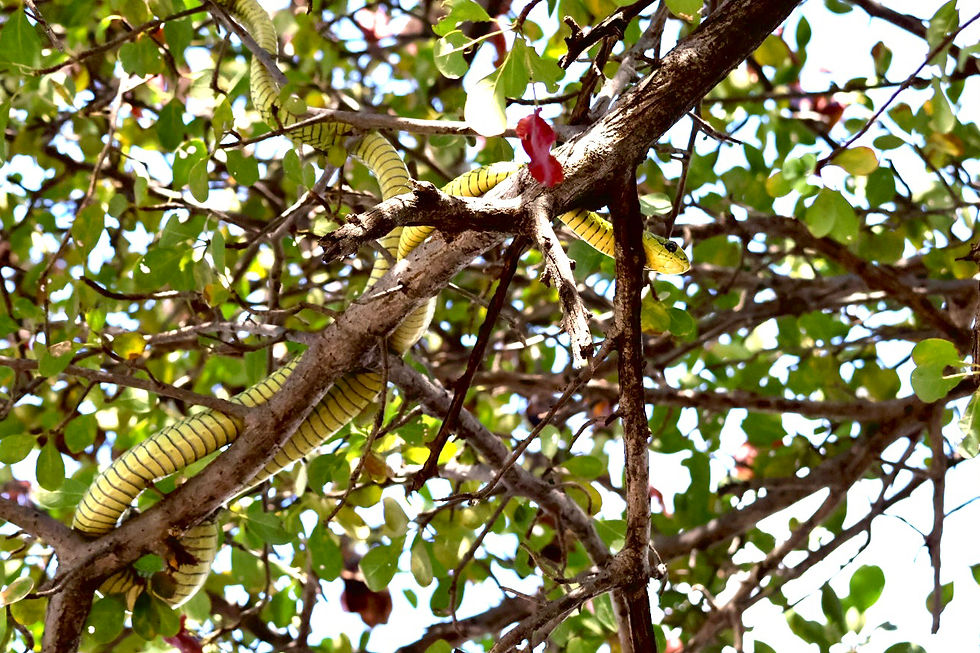
While finishing breakfast at the lodge this morning, we were alerted to a magnificent sighting of a male Boomslang (Dispholidus typus) expertly camouflaged within the canopy of a Purple-pod terminalia (Terminalia prunioides).
The snake was easily identified by the vivid green coloration and black-edged scales characteristic of males in the Kalahari. A significant distension in its midsection confirmed it had recently consumed a substantial meal. It remained tranquil among the dense branches and dark, plum-coloured pods, likely seeking the morning sun to assist with the thermoregulation required for digestion.

Content Creator / Photographer:
Mogomotsi Maboga
Steenbok
Sighted on: 22.May.2026

Steenbok remains one of the most commonly encountered antelopes along the open Kalahari roads and bushveld edges of the reserve. This small, highly alert antelope often pauses for only a few seconds before disappearing into cover with remarkable speed.
Its reddish-brown coat, large ears, and delicate frame blend perfectly with the dry Kalahari landscape. During afternoon drives, steenbok are usually active along quiet road edges, feeding on leaves, shoots, seeds, and small herbs.
Witnessing its explosive escape — sharp turns, high leaps, and lightning-fast sprint into the bush — is always a wow moment for guests. A true symbol of alertness and agility, the steenbok adds excitement to almost every safari drive in the Kalahari.

Content Creator / Photographer:
Zizie Seitaa
Helmeted Guineafowl
Sighted on: 20.May.2026

Helmeted Guineafowl walked gracefully across the dusty Kalahari plains, its pearl-spotted feathers shining beautifully in the afternoon light. The bird displayed a mix of dark grey, white speckles, blue face skin, and a reddish casque above the head.
During afternoon drives, guineafowls are often seen scratching the ground in search of seeds, insects, and fallen berries. They move in groups, constantly alert, using soft calls to communicate while feeding along open pans and roadsides. Most active during early mornings and late afternoons, they avoid the intense midday Kalahari heat by resting under shade.
Among all safari drives, the Helmeted Guineafowl remains the most commonly sighted ground bird in the Kalahari ecosystem.
Content Creator / Photographer:
Zizie Seitaa
Greater Kudu
Sighted on: 18.May.2026

A female kudu was found browsing in the thicket, showcasing her remarkable crypsis. Rather than fleeing, she utilized the "freeze" response, allowing her white lateral stripes to blend with the vertical shadows of the brush. This energy-conserving behavior, combined with her large, radar-like ears, makes the kudu one of the most successful masters of evasion in the region.
Content Creator / Photographer:
Mogomotsi Maboga
Little Bee - eater
Sighted on: 18.May.2026

A pair of these vibrant insectivores was seen hunting from low-lying perches. We witnessed their specialised "bee-rubbing" behaviour striking their prey against the branch to discharge the sting before consumption. Their high site fidelity near moisture-rich areas allows them to capitalize on the high concentration of flying insects typical of the Kalahari pans.
Content Creator / Photographer:
Mogomotsi Maboga
Leopard Tortoise
Sighted on: 17.May.2026

A mature specimen was recorded at the waterhole, a vital sight for this "Little Five" member. In this arid environment, these tortoises spend much of their time aestivating or tucked into the shade of Trumpet thorns to conserve moisture. Seeing an individual actively drinking highlights the importance of localized water points for their thermoregulation and the maintenance of their internal reservoirs.
Content Creator / Photographer:
Comments